There are very few supplements I recommend across the board. Creatine is one of them.
For decades, creatine has been misunderstood as something only bodybuilders or elite male athletes use. That misconception has kept many women from one of the most well-researched, effective, and female-relevant supplements available.
Creatine supports strength, power, muscle mass, brain health, bone integrity, and training quality across the female lifespan, from menstruation through perimenopause and postmenopause. And no, it won’t make you bulky, it doesn’t cause fat gain, and when used properly, it rarely causes bloating.
Let’s break down why creatine matters for women, how it works in female physiology, and how to use it effectively.
What Creatine Is—and Why It Matters for Women
Creatine is a naturally occurring compound stored primarily in skeletal muscle, where it plays a critical role in rapid energy production.
Inside muscle cells, creatine is stored as phosphocreatine (PCr). During short, intense efforts, like lifting heavy weights, sprinting, jumping, or repeated high-intensity intervals, PCr helps regenerate ATP (adenosine triphosphate), the cell’s primary energy currency.
Put simply, creatine helps you produce force faster, repeat high-quality efforts, and recover better between bouts of intense work.
Why supplementation matters for women:
-
About 95% of creatine is stored in skeletal muscle
-
Women naturally have ~70–80% lower intramuscular creatine stores than men
-
Many women typically consume less dietary creatine (it’s found mainly in red meat and seafood)
-
Supplementation can increase muscle creatine stores by ~20%
This makes creatine especially relevant for women who are plant-based, highly active, or entering perimenopause.
I’d like to highlight the work of my friend and fellow academic Abbie Smith-Ryan, whose 2025 article on creatine in women’s health, published in the Journal of the International Society of Sports Nutrition, was the journal’s most-read paper last year.
Her work highlighted how creatine supplementation led to consistent benefits for women when it comes to muscle strength, performance, and body composition, particularly when combined with resistance training. Emerging evidence also suggests benefits for mood and cognitive function, with potential applications during pregnancy and postmenopause. We’ll cover all of these below…
Creatine for Strength, Power, and Performance
Creatine is most effective for:
-
Resistance training
-
Sprinting and HIIT
-
Plyometrics
-
Repeated high-intensity efforts with short rest
Beyond supporting ATP production, phosphocreatine helps buffer hydrogen ions that accumulate during intense exercise. This can help to delay fatigue and allow you to sustain higher training quality.
Do women benefit as much as men? Yes—and sometimes women experience equal or greater relative improvements, likely because our baseline creatine stores are lower. Research consistently shows improvements in:
-
Maximal strength
-
Power output
-
Sprint performance
-
Training volume tolerance
None of this will lead to creatine making you bulky, but it will allow you to train harder and recover better. How your body adapts from there depends on your training, nutrition, recovery, and hormones.
Learn More in My Microlearning Creatine Course
Creatine for Perimenopause & Menopause
As estrogen levels decline in perimenopause and menopause, many women may experience:
-
Reduced neuromuscular efficiency
-
Slower recovery
-
Increased muscle protein breakdown
-
Greater risk of sarcopenia and bone loss
This is where creatine shifts from being a performance supplement to a foundational support nutrient.
Research shows that postmenopausal women who supplement with creatine during resistance training gain more lean mass and strength than those who train without it. Larger trials also suggest creatine helps preserve muscle quality and training capacity as we age.
Creatine supports:
-
Muscle protein synthesis
-
Training intensity despite reduced recovery capacity
-
Neuromuscular signaling
-
Structural components of bone (when paired with resistance training)
Abbie Smith-Ryan and her team are working on research that examines creatine's impact on the psycho-cognitive function of perimenopausal women, so I look forward to seeing the results of this work.
Creatine for Bone Health
Bone responds to mechanical load, and creatine indirectly supports bone health by improving:
-
Muscle force production
-
Training quality
-
Resistance training consistency
Long-term studies in postmenopausal women show that creatine combined with resistance training can:
-
Preserve bone mineral density
-
Improve structural indicators of bone strength
-
Reduce age-related musculoskeletal decline
Creatine alone isn’t a bone supplement, but paired with lifting, it can meaningfully support skeletal health.
Creatine for Brain Health, Cognition, and Mood
Creatine isn’t just stored in muscle, it’s also found in the brain.
The brain has high energy demands, and creatine can help support:
-
Cellular energy availability
-
Neurotransmitter balance
-
Cognitive resilience under stress
This 2023 review highlighted potential benefits of creatine for cognition, mood, and neurological health, particularly relevant for women.
Research shows that women with major depressive disorder who added 5 grams of creatine a day to their standard antidepressant treatment:
-
Responded faster
-
Achieved remission at higher rates
Creatine may also help buffer mood disturbances during phases of the menstrual cycle when hormone-driven neurotransmitter changes increase energy demand in the brain. Although research is ongoing, the evidence is strong enough to consider creatine a brain-supportive nutrient, not just a physical performance aid. This new review (published last month) from Darren Candow and team is an excellent resource on creatine and the brain.
Creatine FAQs
Whenever I post about creatine on social media there’s always a flurry of questions. This tells me two things: women are curious about creatine, and there’s still a lot of misinformation floating around. For this reason, I've set up a dedicated Creatine FAQs page where you can find science-based, female-focused answers to questions such as "Will creatine make me bloated?", "Does creatine cause hair loss?", and plenty more.
Check out my Creatine FAQs page
How to Supplement Creatine
Creatine comes in many forms (monohydrate, micronized, HCl) but by far the most widely researched form is creatine monohydrate. I recommend CreaPure®, as it is produced using a water-based process, which usually leads to fewer GI side effects than cheaper acid-washed alternatives. It is also rigorously tested and free from contaminants and banned substances. (Note that as a consumer you can’t buy Creapure directly; it is a B2B product that supplement manufacturers buy to use in their creatine products). Always look for supplements that are independently third-party tested by organizations like NSF or Informed Sport.
Dosing: There’s no real need to take more than 3-5 grams a day under normal circumstances, and if you’re unsure about that, start with just 1-2 grams. You can mix it into water, smoothies, oatmeal, or recovery drinks; it’s tasteless and easy to use.
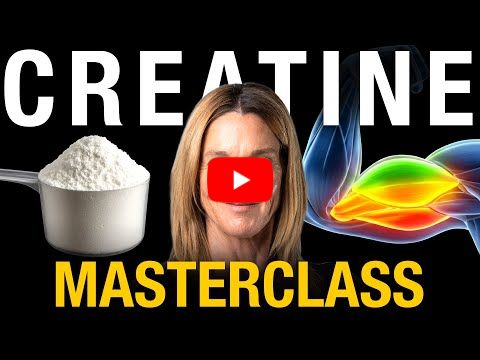
You can learn more about getting started in this short YouTube clip below:
|


Here’s a compilation of some of the most important conversations I’ve had around creatine: what it actually does (beyond the gym), why it’s especially relevant for women, and how to use it without getting caught up in outdated bodybuilding myths.
|
Beware of Fake Stacy!
I’m a huge fan of technology and definitely appreciate AI when it is used constructively, but recently there’s been a rise in unauthorized AI-generated “books” using my name and work. Please be aware that I’ve only written two books: ROAR and Next Level. If you see any books or work that looks unauthorized please get in touch with us at support@drstacysims.com. Thank you!
Join Our Q&A to Support the Ellie Fund
I’ll be hosting a special Zoom Q&A on March 10 at 7 p.m. EST with Dr. Amy Comander, a Harvard breast oncologist and advocate for using exercise to support recovery during and after cancer treatment. The Q&A—Fuel, Move, and Lift with Dr. Stacy Sims—is a fundraiser for Amy’s Boston Marathon, which she’s running to raise money for the Ellie Fund. The fund provides essential support services for breast cancer patients to ease the stresses of everyday life so they can focus on family, recovery and healing. If you’d like to sign up for the Q&A you can do so here, and donations to the Ellie Fund can be made here.

Until next time,